Setback intervals based on exit codes
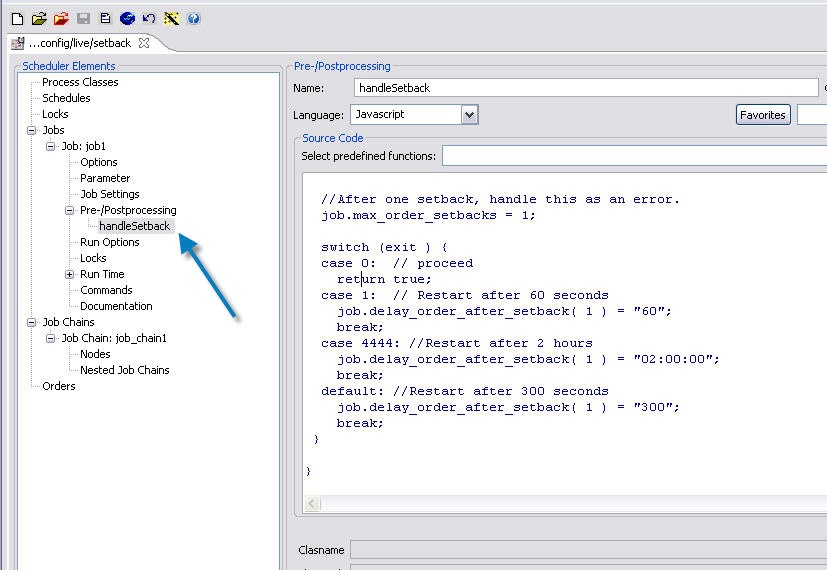
If you want to set different setback intervals depending on the exit code then you can use the internal API by defining a post-processing routine after the task.
In this example, we define a job in a job chain.
- When the job ends with exit code 1 then try again in 60 seconds
- When the job ends with exit code 444 then try again in 2 hours
- When the job ends with other non-zero exit codes then try again in 300 seconds
Perform the following tasks with JOE:
- Define a post-processing function spooler_task_after()
- Code the switch with your requirements.
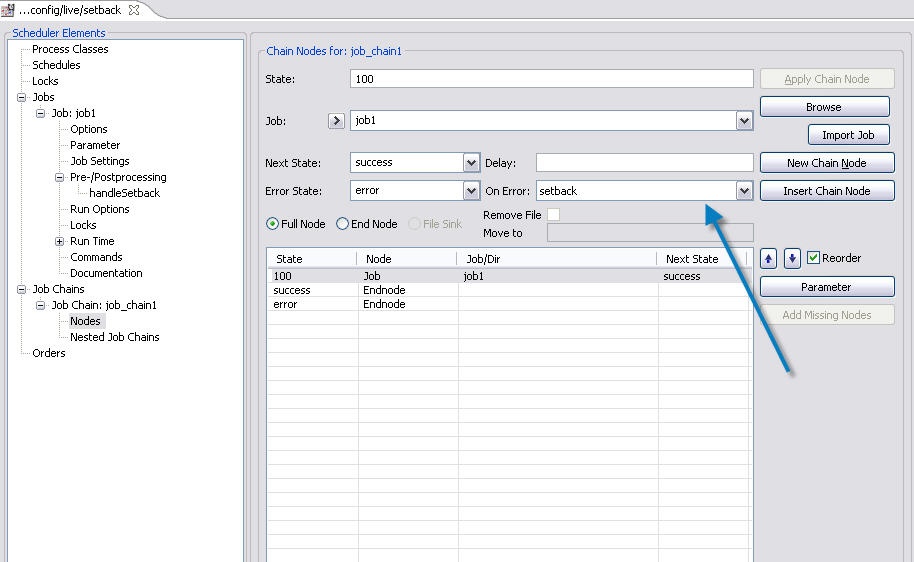
- Add the job to a job chain. Do this even you only have one job in the chain.
XML Configuration of the Job
<?xml version="1.0" encoding="ISO-8859-1"?>
<job order="yes"
     stop_on_error="no">
    <script language="shell">
        <![CDATA[
exit 1
        ]]>
    </script>
    <monitor name="handleSetback"
             ordering="0">
        <script language="java:javascript">
            <![CDATA[
function spooler_task_after() {
  var exit = spooler_task.exit_code;
  var job = spooler_task.job;


  // After one setback, handle this as an error.
  job.max_order_setbacks = 1;


  switch (exit ) {
  case 0:  // proceed
    return true;
  case 1:  // restart after 60 seconds
    job.set_delay_order_after_setback( 1, "60" );
    break;
  case 4444: // restart after 2 hours
    job.set_delay_order_after_setback( 1, "02:00:00" );
    break;
  default: // restart after 300 seconds
    job.set_delay_order_after_setback( 1, "300" );
    break;
 }
}
            ]]>
        </script>
    </monitor>
    <run_time/>
</job>
XML configuration of the Job Chain
 <job_chain>
    <job_chain_node state="100"
                    job="job1"
                    next_state="success"
                    error_state="error"
                    on_error="setback"/>
    <job_chain_node state="success"/>
    <job_chain_node state="error"/>
 </job_chain>